

Called as Christ's Disciple (LD 8; Matthew 28:16-20)
Redemption is more than personal salvation—it is an invitation into communion with the Triune God. In this message, we see how the Father elects, the Son redeems, and the Holy Spirit gives life, securing both our identity and the church’s mission under Christ’s authority.
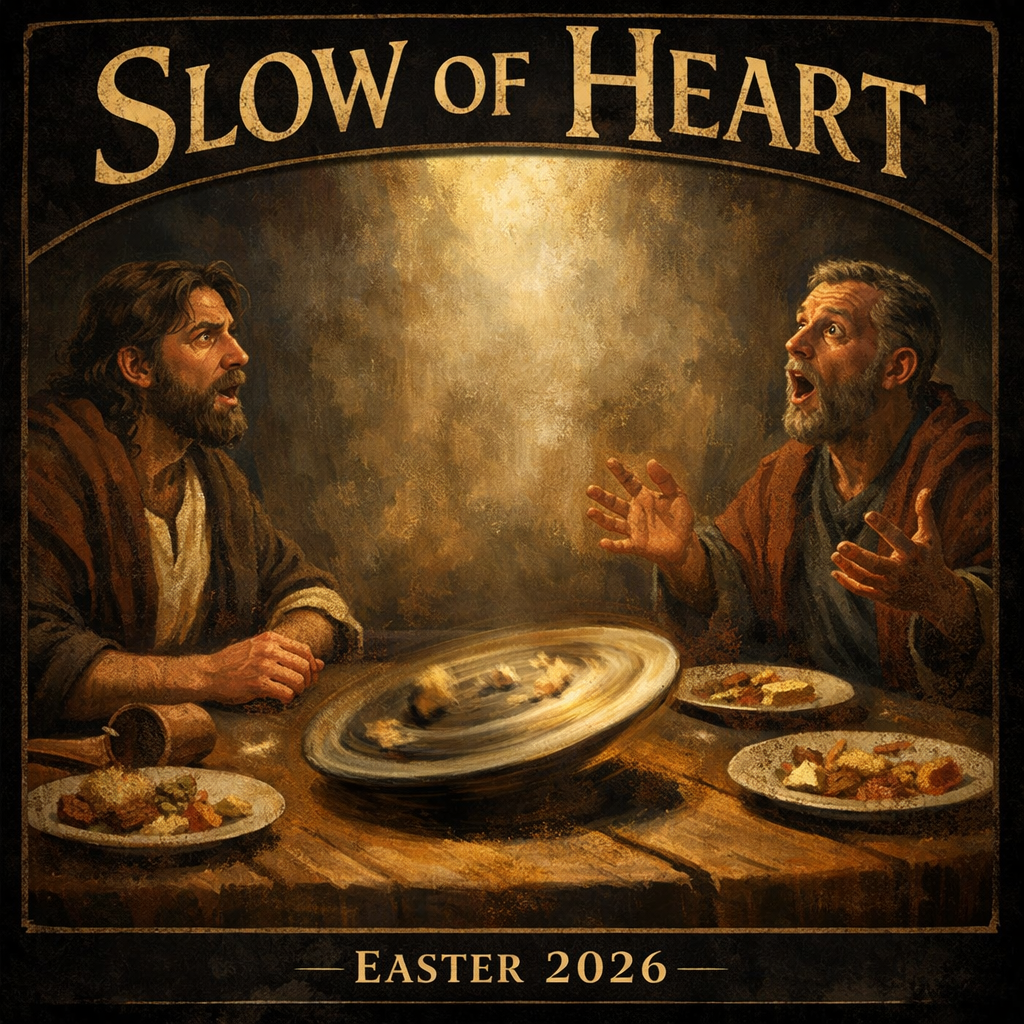
Slow of Heart (Luke 24:25-27)
Slow of heart and clouded by expectation, the disciples on the road to Emmaus could not reconcile a suffering Messiah with their hopes for glory. Yet the resurrection reveals what they missed: Christ’s suffering was not failure, but the very path to victory. In rising from the grave, God vindicates His Son, overturns the verdict of earthly courts, and confirms every promise spoken through the prophets. Even in their confusion, Christ does not abandon His followers—He walks with them, teaches them, and welcomes them to the table.

Good Friday: The Outside Witness (Luke 23:47)
In a moment of profound injustice, when everything appears lost, a hardened Roman centurion sees what others miss. He watches the innocent Christ suffer without resistance, hears Him pray for His enemies, and witnesses a death unlike any other.
This is no ordinary execution. This is no failed revolutionary.
And so the man who has seen everything, who trusts nothing lightly, speaks the truth: this man is righteous.
While others grieve from a distance, the centurion draws near in understanding. He sees that this suffering is not accidental—it is purposeful. The righteous servant is bearing the weight of sin.
This is what makes Good Friday good.

The Ultimate Goal: Complete Transformation into Christ's Likeness | Series Finale (Chapter 10)
What is the ultimate goal of the Christian life? This message explores sanctification as a lifelong transformation into Christ’s likeness—through imitation, participation, and union with Him.
Possessing Christ (LD 7; Romans 10:14-17)
What does it really mean to say, “we belong to the Lord”? For some, it sounds like control or burden—but the gospel reveals something entirely different. In Christ, we are not owned as servants under tyranny, but held as redeemed people invited into wholeness, assurance, and rest. True faith is more than knowledge—it is a deep trust that says “Amen” to God’s promises and reshapes our lives around them. And even the question, “Is this Christ really my Christ?” is itself a sign of grace at work, drawing us back to the Savior who calls, keeps, and restores his people.
Conclusion: The Rest of the Story (Esther 9:20-10:3)
Esther concludes with the feast of Purim. The celebration of God's sovereign protection over his people. Through Mordecai the historian, a new redemptive anchor point, and the reminder that this age is not yet glory, we learn to distrust earthly kingdoms, resist despair, and live as a resurrection people between Christ's raising and his return.
Our Eternal Solution (1 Corinthians 1:18-25; LD 6)
Only a divine person united to a human nature can absorb eternal wrath in a moment of time. Only Christ is such a mediator… At Christ's weakest moment, he won the greatest victory. The world will call it foolishness. Paul’s response: ‘Fine. Call it folly. In that folly is life.

Keep Going: How to Persevere in Holiness When You're Weary | Hebrews 12:1-2 (Chapter 9)
Run the race of faith with endurance. In this message from Hebrews 12:1–2 and Devoted to God (Chapter 9), we explore how to lay aside distractions, fight sin, and fix our eyes on Jesus as we persevere in holiness together.
Holy War: Feasting and Devotion to Destruction (Esther 9:1-19)
Esther 9 reveals a sobering and hope-filled picture of God’s justice and salvation. As the Jews move from threatened destruction to victorious celebration, we see a deeper reality unfolding: a cosmic conflict between God’s unshakable decree and the fading power of earthly kingdoms. This sermon explores holy war, divine judgment, and the promise of final rest, pointing us to Christ. He is the One who secures both our deliverance and our future feast. Will we bow to Him now in joy, or later in terror?
The Law Goes Deep: God's Law in the Life of Grace | Romans 8:4 & Matthew 5:17 (Chapter 8)
What's the role of God's law if we're saved by grace? In this session from Sinclair Ferguson's Devoted to God, we explore how Christ fulfills the law, how the Spirit empowers obedience, and why law and grace work together rather than against each other.
Law gives direction. The Spirit gives power. And in Christ, duty becomes delight.

Relationship in the Church (1 Peter 4:7-11)
The sermon on 1 Peter 4:7-11 reminds us that "the end of all things is at hand" is not a cause for fear but a joyful declaration of the new reality we inhabit since Christ's ascension and the outpouring of the Holy Spirit: born again by grace alone into His kingdom, we live as pilgrims with one eye on the present world and one on the glory to come. In light of this, Peter calls believers to cultivate church relationships that glorify God through four key imperatives—being sober-minded for effective prayer, loving one another earnestly with constant forgiveness that covers a multitude of sins, showing genuine hospitality without grumbling by sharing life’s joys and sorrows, and serving one another with the gifts God has graciously given us, identified not by self-assessment but by meeting others’ needs in word and deed. Though we fall short daily, God is glorified in these imperfect relationships through Jesus Christ—His perfect work, intercession, sanctifying Spirit, and sacrificial example—foreshadowing the eternal fellowship awaiting us when He returns, drawing us closer to our Savior and one another.
Our Eternal Problem (Matthew 25:35-46; LD 4)
We are tempted to solve sin the same way we solve everything else — with strategy, discipline, or distance. But as Luther reportedly said of his time in the monastery, "I went to escape the rascal, only to find that the rascal followed me there." The problem isn't out there. It's in here. And only one solution reaches that deep.
God's Glorious Projection (Esther 8:1-17)
Haman is dead — but his decree isn't. The villain has been removed, but his villainy still stands. In Esther 8, we're confronted with a sobering reality: one evil man can be toppled, yet the damage he set in motion keeps moving. So what does God do? He doesn't cancel the decree. He issues a better one. This is the pattern of redemptive history — God doesn't simply undo the enemy's work, He overwhelms it.
Chapter 7 - “In For the Kill”
Are you ready to fight sin with gospel hope? In this powerful message on sanctification, we explore Chapter 7 of Sinclair Ferguson's "Devoted to God" titled "In for the Kill"—learning how to actively put sin to death through the Spirit's power.
God’s Fault? (LD 3; Genesis 3)
Why does life often feel frustrating and broken? Genesis 3 reveals the deeper story behind our world: God’s perfect creation, humanity’s rebellion, and the lasting consequences of the fall. Yet even in the midst of judgment, God gives the first promise of the gospel—a Redeemer who will defeat the serpent and restore His people.
Ironic Exaltation (Esther 7:1-10)
In a kingdom where decrees cannot be undone, Esther stands between her people and destruction. What begins as hesitation becomes one of Scripture’s boldest moments of faith. As Esther exposes Haman’s wickedness and risks everything to identify with God’s covenant people, we glimpse a deeper story — of justice, irony, and redemption. Through Esther’s courage and Haman’s downfall, we see God’s unwavering purpose: to preserve His people and point us to the Redeemer who hung on the tree in our place.
The New Rhythm of Grace: How Sanctification Transforms Your Christian Life | Colossians 3 (Chapter 6)
Sanctification is not self-effort but a new rhythm of grace. In this episode, we explore Colossians 3 and Sinclair Ferguson’s teaching on union with Christ, renewal, and learning to put on Christ in daily life.
Misery or Mercy? (Psalm 19:7-14; LD 2)
If God’s law reveals our sin and misery, why does Psalm 19 celebrate it as life-giving? The Heidelberg Catechism teaches that the law exposes how deeply we fall short, yet Scripture also describes God’s instruction as perfect, joyful, and renewing to the soul. This study explores how God’s law leads us not to despair, but to Christ—our Redeemer—who enables us to live in gratitude, reverence, and dependence upon Him.
Mordecai's Ironic Reward (Esther 6:1-14)
When God's people face annihilation, we expect a burning bush, ten plagues, or some dramatic miraculous intervention. Instead, God sets his entire plan in motion through a single sleepless night. The book of Esther reminds us that God's silence is never God's absence — he is working through the most mundane details of human life to ensure that his promises cannot fail.
The Conflict Zone: Walking by the Spirit vs. the Flesh (Galatians 5) | Devoted to God Series (Chapter 5)
The Christian life is a daily battle between the flesh and the Spirit. In this episode, we explore Galatians 5 and Sinclair Ferguson’s teaching on walking by the Spirit and living devoted to God in the midst of spiritual conflict.